Formnext 2026 PDF brief

Frankfurt · 17–20 November 2026

Why these parts
were 3D printed.

An exhibition report and part catalog from Formnext 2026. Explore where additive manufacturing improved performance, reduced weight, simplified assembly, or made a new design possible.

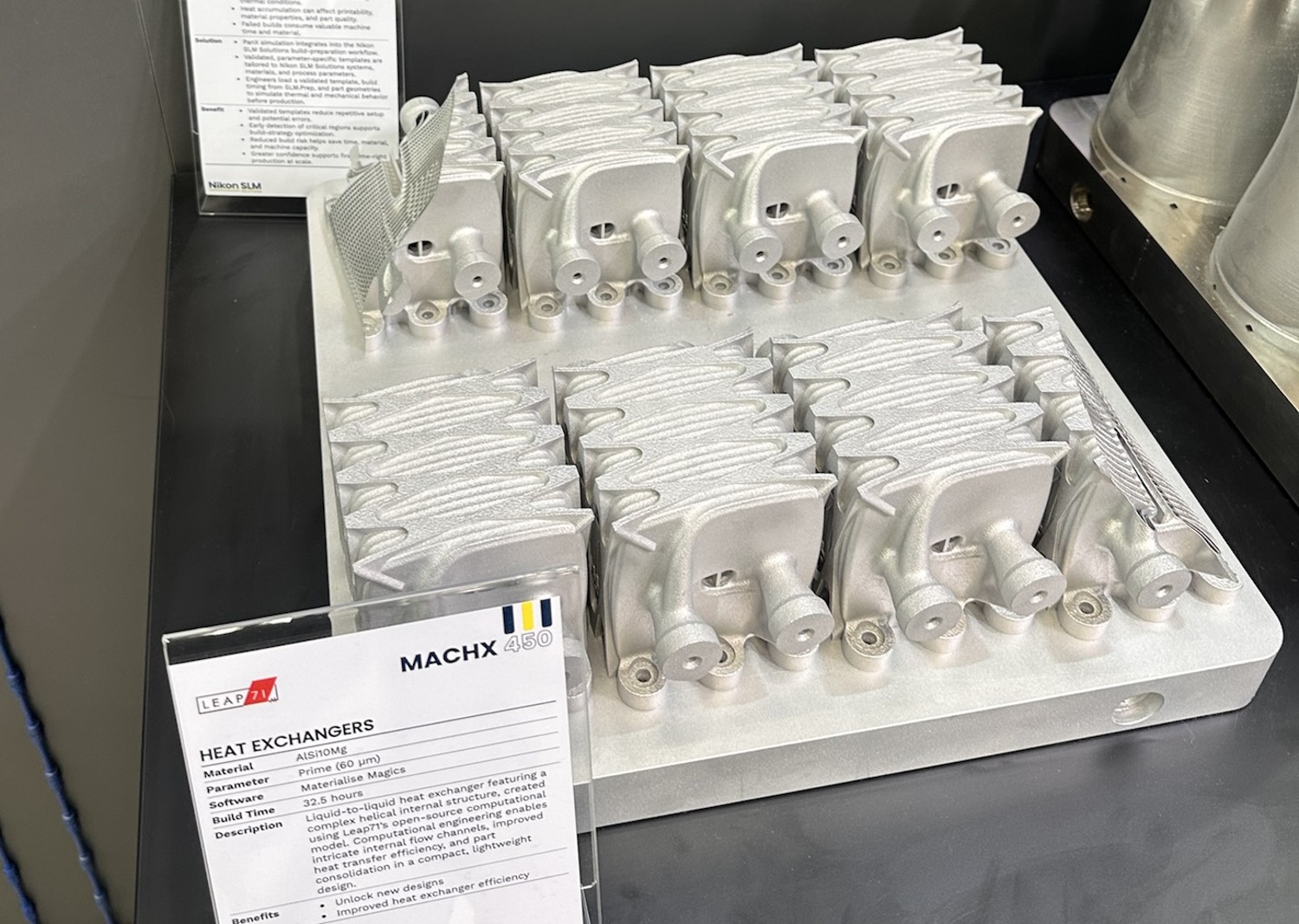
A build plate packed with silver LEAP 71 heat exchangers, each with a ridged body and two circular ports
Nikon SLM / LEAP 71Liquid-to-liquid heat exchangers · IMG_1183

Performance led the captured applications.

25 of 76 application and material-sample families primarily targeted a functional gain. Thermal parts drove much of that count. Lightweighting led in seven of 13 mobility and robotics families.

See what changes by industry

Primary reason for printing

76 application and material-sample families

Part explorer

Search 76 application families and 11 technology or display records. Open a part for its rationale and evidence.

Catalog matching current filters
Exhibit / printed partIndustryPrimary reasonEvidenceDetails

The case for printing varies by industry.

Choose an industry to compare the parts, their design intent, and the evidence behind it.

What the production figures measure

The build stage, assembly and finished-part economics each use a different denominator.

Where printing adds value

Trace the workflow to the actual part or surface used.

Direct part
Printed passages or load paths define the function. Check geometry and finish at the intended duty.
Near-net blank
Deposition creates a shape for machining. Compare the finished part after machining and inspection.
Pattern or tool
The printed tool supports a later casting or molding step. Measure time and cost to the usable downstream part.
Printed surface
On the Stratasys samples, the printed relief and the existing fabric jointly form the finished textile.

From printer to production line

What the machines and workflow demonstrations added to the part exhibits.

Metal parts and batch builds

Nikon SLM’s MACHX display brought together heat exchangers, microjet diffusers and V8 cylinder heads. BLT and Farsoon used packed build plates to show how part size and placement shape a production run.

Nikon SLM’s Formnext exhibit ↗

Polymer production and materials

EOS’s HELIOR launch and powder wall addressed two separate questions: how to increase build capacity and which material properties suit each application. The Formlabs display showed washing and curing as separate stages.

EOS HELIOR announcement ↗

Finishing and inspection

Meltio and Caracol illustrated alternative deposition routes. AM Flow showed identification, inspection, sorting and bagging. A production comparison needs to include the work that happens after the build.

AM Flow’s production line demo ↗

Evidence from the show floor

Local photos and clips from 20 November, with Formnext uploads from 22–24 November 2026.

Video index
Formnext Shorts37 videos
Displays awaiting identification5 displays
    Counting and evidence method
    Organizer and exhibitor references